
Dog Stories
Dear Friends,
In the valley below W.S. Merwin and Paula Merwin’s house, a dry streambed makes its way down to the ocean. It’s one of my favorite places in the garden, a lovely place to pause and imagine William walking up the streambed, against a silent and invisible current. (His poem “One Valley,” written with this very place in mind, is also a favorite.) William built a small bridge across the streambed, clearly not to keep from getting wet, and not even because it’s particularly deep or tricky to negotiate, but rather so his beloved and aging dog could make her way to the other side. I don’t know the name of this dog, but I heard William say, the most recent time I watched the documentary Even Though the Whole World is Burning, that she accompanied him everywhere. And, he said, “If she’s not in the next world, I don’t want to be there.”
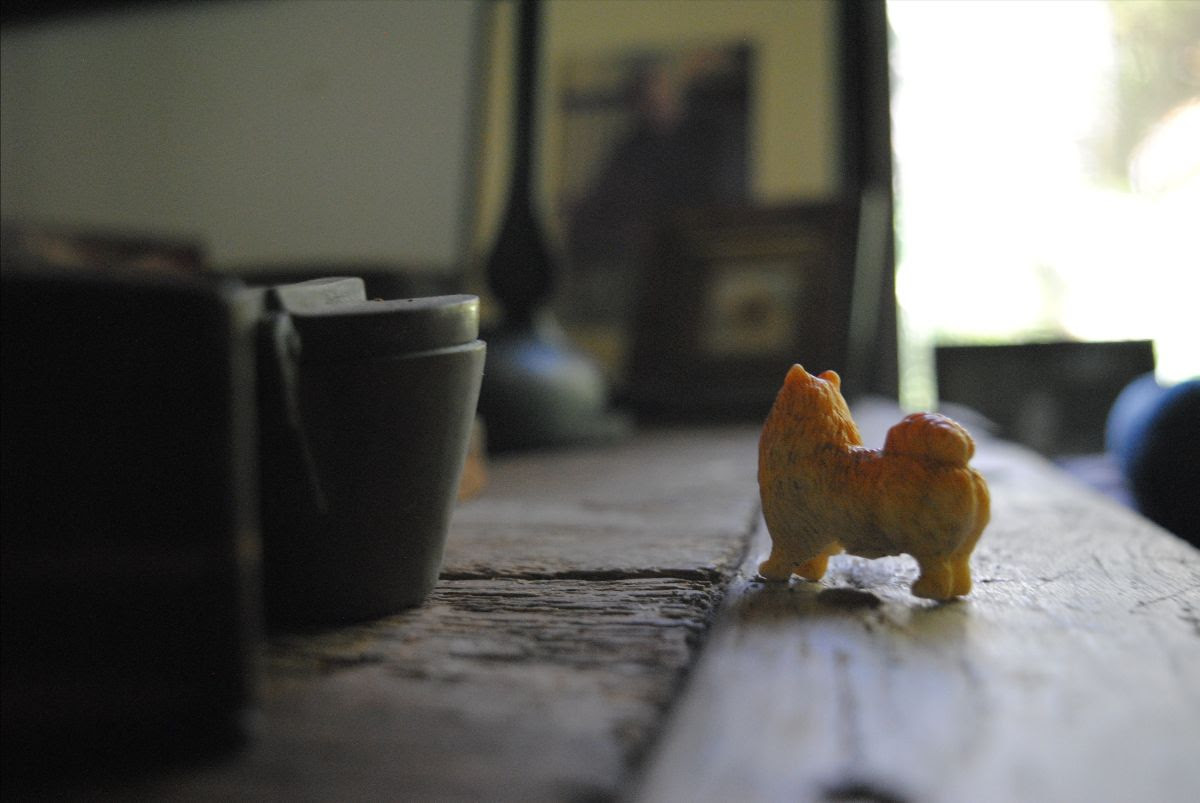
In this world, and in the world within the Merwins’ home, so many of the objects and documents I am finding hold stories of the many dogs—all chows—who lived and are buried here. A pair of blue ceramic dog bowls still sits on the front lanai, near the gardening tools; a small chow figurine trots across William’s desk, toward his painted likeness, propped up in a tiny frame. Here in William’s study, a poster still tacked to the door reads REWARD—FOR RETURN OF LOST OR STOLEN DOG. RED CHOW, CREAM COLORED TAIL, BLACK TONGUE. GENTLE. 50 LBS. And in a file drawer, kept across the years, notes from someone who stayed here to care for the dogs during William and Paula’s time away offer detailed updates on the chows’ well-being.
As we all make our way through these times, as we at The Merwin Conservancy plan for a future of sharing this place, and as I consider the intentionality and importance of things in this house, I think about compassion. William’s care for the world and for all living things within it wasn’t sentimental. His compassion was unceremoniously enacted through deep friendships with people, animals, places, and palms alike. The belief that humans are part of the natural world (there is, after all, no other) and have an ethical responsibility to participate actively in caring for it, is one that will undergird our growth. When I envision a future well beyond our current moment, I see the Conservancy as a generative site, where through hand, mind, and imagination, we enact our care for each other and for the world.
With warm wishes,
Sonnet
